How APEX Processes Various Conditions and Validations
I was recently teaching an Intro to APEX course and the students had some questions about what to put in the Expression 1 text area for different conditions and validations based on the Type selected. If you're new to APEX the various options can be confusing.
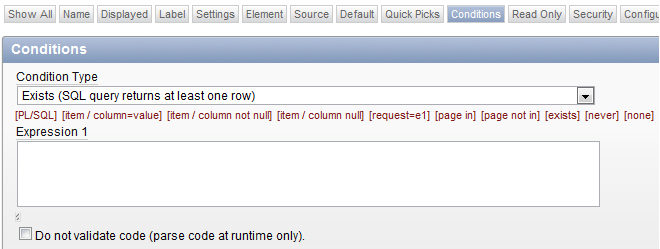
_Note: the calls to DBMSOUTPUT are there to show you if the validation/condition is true or false.
Exists
DECLARE
  l_rows pls_integer;
BEGIN
  SELECT count(1)
  INTO l_rows
  FROM (
    -- Start Expression 1
    SELECT 1
    FROM emp
    WHERE sal > :p1_sal
    -- End Expression 1
  );

  IF l_rows > 0 THEN
    dbms_output.put_line('TRUE');
  ELSE
    dbms_output.put_line('FALSE');
  END IF;
END;
/
**Not Exists**
DECLARE
  l_rows pls_integer;
BEGIN
  SELECT count(1)
  INTO l_rows
  FROM (
    -- Start Expression 1
    SELECT 1
    FROM emp
    WHERE sal > :p1_sal
    -- End Expression 1
  );

  IF l_rows = 0 THEN
    dbms_output.put_line('TRUE');
  ELSE
    dbms_output.put_line('FALSE');
  END IF;
END;
/
**SQL Expression**
_Note: SQL Expression and PL/SQL Expression are very similar but some SQL expressions can't be used in PL/SQL. Example: Decode_
DECLARE
  l_rows pls_integer;
BEGIN
  SELECT count(1)
  INTO l_rows
  FROM dual
  WHERE
    -- Start Expression 1
    :p1_sal > 500
    -- End Expression 1
  ;

  IF l_rows = 1 THEN
    dbms_output.put_line('TRUE');
  ELSE
    dbms_output.put_line('FALSE');
  END IF;
END;
/
**PL/SQL Expression**
DECLARE
BEGIN
  IF (
    -- Start Expression 1
    :p1_sal > 500
    -- End Expression 1
  ) THEN
    dbms_output.put_line('TRUE');
  ELSE
    dbms_output.put_line('FALSE');
  END IF;

END;
/
**PL/SQL Function Returning Boolean**
DECLARE
  FUNCTION f_apex_condtion RETURN boolean
  AS
  BEGIN
    -- Start Expression 1
    DECLARE
      l_rows pls_integer;
    BEGIN
      SELECT count(*)
      INTO l_rows
      FROM emp
      WHERE JOB = 'PRESIDENT';

      IF l_rows > 1 THEN -- only want at most 1 president
        RETURN FALSE;
      ELSE
        RETURN TRUE;
      END IF;
    END;
    -- End Expression 1
  END;

BEGIN

  IF f_apex_condtion THEN
    dbms_output.put_line('TRUE');
  ELSE
    dbms_output.put_line('FALSE');
  END IF;

END;
/
**_Conditions Only_**
**Function Returning Error Text**
DECLARE
  l_err_msg varchar2(4000);

  FUNCTION f_apex_condtion RETURN varchar2
  AS
  BEGIN
    -- Start Expression 1
    DECLARE
      l_rows pls_integer;
    BEGIN
      SELECT count(*)
      INTO l_rows
      FROM emp
      WHERE JOB = 'PRESIDENT';

      IF l_rows > 1 THEN
        RETURN 'Only 1 president can exist for the company';
      ELSE
        RETURN NULL; -- no error
      END IF;
    END;
    -- End Expression 1
  END;

BEGIN
  l_err_msg := f_apex_condtion;

  IF l_err_msg IS NULL THEN
    dbms_output.put_line('TRUE');
  ELSE
    dbms_output.put_line('FALSE - Error message: ' || l_err_msg);
  END IF;

END;
/
**PL/SQL Error**
DECLARE

  PROCEDURE sp_apex_condtion AS
  BEGIN
    -- Start Expression 1
    DECLARE
      l_rows pls_integer;
    BEGIN
      SELECT count(*)
      INTO l_rows
      FROM emp
      WHERE JOB = 'PRESIDENT';

      IF l_rows > 1 THEN
        raise_application_error(-20001, 'Only 1 president can exist for the company');
      END IF;
    END;
    -- End Expression 1
  END;

BEGIN
  sp_apex_condtion;

  dbms_output.put_line('TRUE');

exception WHEN others THEN
  dbms_output.put_line('FALSE'); -- Error message is defined in the validation's error message
END;
/